



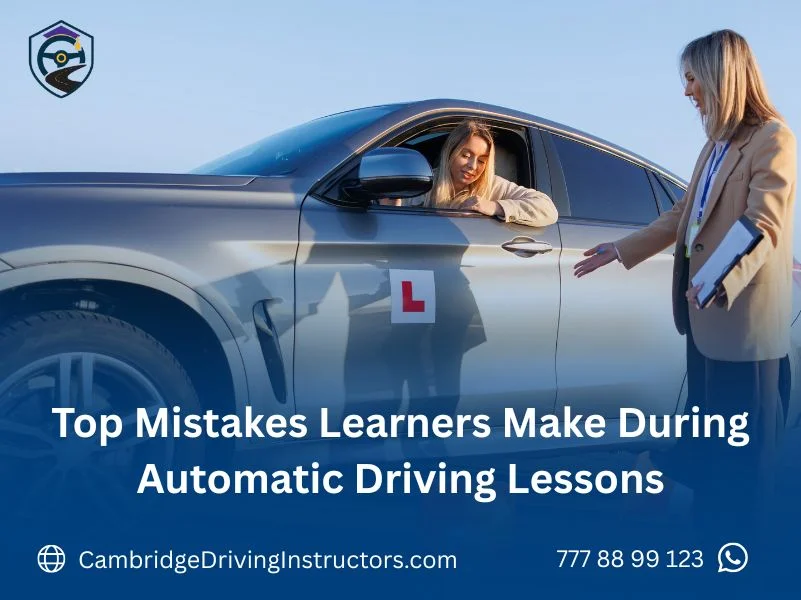
Learning to drive an automatic car should be straightforward, right? No clutch to worry about, no gear changes to master – just accelerate and brake. Yet after years of teaching automatic driving lessons in Cambridge, I’ve noticed that learners consistently make the same mistakes, regardless of their age or background. The good news? Every single one of these errors is easily correctable once you understand what’s happening and why.
1. The Left Foot Trap: Using Both Feet to Drive
This is perhaps the most common mistake I see during automatic driving lessons, and it’s completely understandable. Many learners instinctively want to use both feet – left for brake, right for accelerator – because it seems logical. However, this habit can be genuinely dangerous.
Why it’s problematic: In emergency situations, panic causes us to push both feet down simultaneously. With both feet on the pedals, you’ll hit both the brake and accelerator at once, creating confusion and potentially making the situation worse. Additionally, resting your left foot on the brake pedal causes premature wear and keeps your brake lights illuminated, confusing drivers behind you.
The solution: From your very first automatic driving lesson, train yourself to use only your right foot for both pedals. Tuck your left foot away to the left of the footwell. This might feel awkward initially, but within a few lessons, it becomes completely natural. Your reaction times will actually improve because your right foot simply moves between two pedals rather than coordinating two separate feet.
2. Misunderstanding Creep Function
Automatic cars have a feature called “creep” – the car moves forward slowly when you release the brake, even without touching the accelerator. Learners often either don’t understand this function or become overly dependent on it.
The mistake: Some learners panic when the car starts moving on its own, slamming on the brake unnecessarily. Others become so reliant on creep that they forget to use the accelerator properly, causing them to hold up traffic or struggle on inclines.
What you should do: Embrace creep as a useful tool for slow-speed maneuvers like parking or navigating tight spaces, but don’t depend on it exclusively. On flat roads and slight inclines, creep is your friend for smooth starts. However, on steeper hills in Cambridge (yes, we have a few), you’ll need to coordinate the brake and accelerator for a controlled move-off. Practice finding the “bite point” with your accelerator before releasing the brake on hills.
3. Incorrect Use of Park, Reverse, Neutral, and Drive
The gear selector in an automatic seems simple, but learners frequently misuse it, particularly when it comes to Neutral and Park.
Common errors include:
- Shifting into Neutral at traffic lights (unnecessary and potentially dangerous if you roll)
- Moving into Park before the car has completely stopped
- Forgetting to engage Park when parking and relying only on the handbrake
- Not understanding when to use each gear position
Proper practice: Drive (D) is for moving forward – simple enough. Reverse (R) is for backing up, but always come to a complete stop before shifting from Drive to Reverse or vice versa. Neutral (N) is rarely needed in everyday driving; use it primarily during a breakdown when the car needs to roll freely. Park (P) should be engaged every time you park and exit the vehicle – it physically locks the transmission. Always come to a complete stop, apply the handbrake first, then shift into Park. This sequence protects your transmission from unnecessary stress.
4. Poor Observation and Spatial Awareness
Here’s a mistake that transcends transmission type: learners assume that because driving an automatic is “easier,” they can pay less attention to their surroundings. This couldn’t be further from the truth.
The reality: Automatic cars respond more quickly to accelerator input than manuals, and without gear changes to break up your attention, some learners develop a false sense of security. I’ve watched learners focus so intently on the mechanics of driving that they miss crucial observations – pedestrians at crossings, cyclists in blind spots, or changes in speed limits.
Developing good habits: Driving an automatic actually frees up mental capacity that you should redirect toward observation and anticipation. Use your mirrors every few seconds, perform thorough blind spot checks before maneuvers, and constantly scan the road ahead for potential hazards. In Cambridge’s busy streets, with cyclists, buses, and pedestrians all competing for space, observation isn’t optional – it’s essential for safety.
5. Accelerator Control and Smooth Driving
The sensitivity of automatic car accelerators catches many learners off guard. Unlike manuals, where the clutch provides a buffer, automatics respond immediately to your foot movements.
Typical mistakes: Jabbing at the accelerator causes jerky motion that makes passengers uncomfortable and signals poor control. Being too timid with the accelerator causes you to hold up traffic and creates frustration for other road users. Finding that balance is crucial.
Mastering control: Think of the accelerator as a dimmer switch, not an on-off button. Apply pressure gradually and smoothly. When approaching junctions or roundabouts, ease off the accelerator gently rather than suddenly lifting your foot. Practice progressive acceleration – increasing pressure steadily as you build speed. During your automatic driving lessons, your instructor should help you develop this feel, but conscious practice makes perfect.
6. Neglecting the Handbrake
Because automatic cars won’t roll backward on hills as easily as manuals (thanks to transmission design), some learners neglect the handbrake entirely.
Why this matters: The handbrake isn’t just for parking – it’s a safety device that should be used whenever you’re stopped for more than a few seconds. It prevents rolling, reduces strain on your braking system, and signals to other drivers that you’re stationary.
Best practice: Apply the handbrake at traffic lights, in queuing traffic, and obviously when parking. On hills, coordinate releasing the handbrake with applying the accelerator for smooth hill starts. During your Cambridge driving lessons, practice this coordination until it becomes second nature.
7. Overconfidence Leading to Complacency
This is perhaps the most insidious mistake. Learners often progress quickly with automatics because there’s less to coordinate physically. This rapid progress sometimes breeds overconfidence.
The danger: Overconfident learners stop actively learning. They become complacent about observations, speed management, and anticipation. They take their practical test before they’re truly ready and either fail or, worse, pass but lack the skills for safe independent driving.
Staying grounded: Remember that passing your test is just the beginning. Every automatic driving lesson should challenge you to improve – whether that’s perfecting roundabout positioning, enhancing hazard perception, or developing smoother driving technique. Work with your instructor to identify areas for improvement, even when you feel confident.
Moving Forward with Confidence
Learning to drive an automatic doesn’t mean learning to drive carelessly. The absence of clutch control doesn’t diminish the importance of observation, spatial awareness, and decision-making. By recognizing these common mistakes early in your learning journey, you’ll develop into a safer, more competent driver.
At Cambridge Driving Instructors, we’ve helped hundreds of learners master automatic driving by addressing these issues from the very first lesson. We don’t just teach you to pass a test – we prepare you for a lifetime of safe, confident driving on Cambridge’s unique roads and beyond.
Frequently Asked Questions
Is it harder to learn automatic or manual?
Automatic is easier and faster to learn. No clutch or gear changes, so learners focus on road awareness and decision-making. Most automatic learners are test-ready in 20–30 hours, compared to 40–45 hours for manual. Easier doesn’t mean careless though—safe driving skills still matter.
Should I use my left foot to brake in an automatic?
No. Always use your right foot only for both accelerator and brake. Left-foot braking is dangerous, causes panic errors, and leads to unnecessary brake wear. One foot is safer and quickly becomes natural.
When should I use Park (P) or Neutral (N)?
Use Park (P) when parking or leaving the car—it locks the transmission.
Neutral (N) is rarely needed, mainly if the car breaks down or is being towed. Don’t use Neutral at traffic lights; staying in Drive is safer and fine for modern automatics.
How many automatic lessons will I need before my test?
Most learners need 20–30 hours, depending on confidence, experience, practice frequency, and hazard perception. Regular lessons help you pass faster. The goal isn’t rushing the test—it’s becoming a safe, confident driver.
Ready to start your automatic driving lessons with an instructor who understands these challenges? Get in touch with Cambridge Driving Instructors today, and let’s build your skills the right way from day one.